Our Technology Director, Max Hatamian, dives into the world of vibe coding, what it means for brands, creators, and developers, and how it can be applied to accelerate innovation. He also offers a warning: when the vibes are off, you need to call skilled developers.
Remember the days of app development requiring months of learning software language syntax, wrestling with frameworks, and debugging until the early hours of the morning? Those days aren’t entirely gone, but they’re rapidly evolving. Welcome to the era of vibe coding, where you describe what you want in plain English, and AI tools transform your ideas into working code.
What is vibe coding?
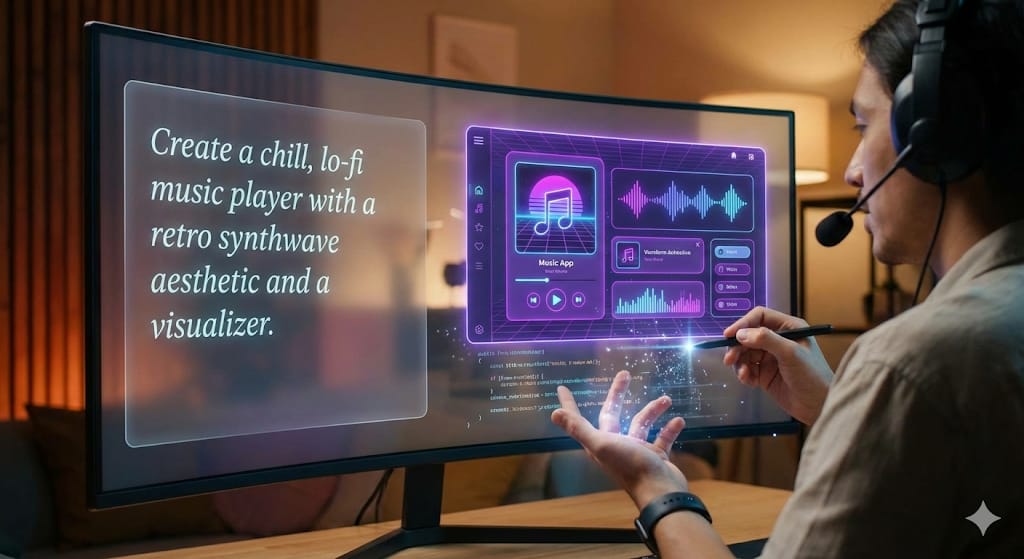
Imagine being able to describe your software ideas in the language of your choice and watch them come to life instantly. That’s the promise of vibe coding, a new approach that’s transforming how products are prototyped, tested, and deployed.
Whether you’re a brand looking to rapidly prototype digital experiences, a designer eager to bring interactive concepts to life, or a developer exploring new ways to streamline workflows, vibe coding offers tools that make experimentation faster and more accessible than ever. From simple animations to functional mini-apps, the possibilities are limited only by your imagination.
Vibe coding is a shift in how we create software. Instead of developers writing lines of code, anyone can now describe in natural language the requirements and let AI models handle the implementation.
Andrej Karpathy, who coined the term vibe coding in Feb 2025, put it: “There’s a new kind of coding I call ‘vibe coding’, where you fully give in to the vibes, embrace exponentials, and forget that the code even exists.” See original post here.
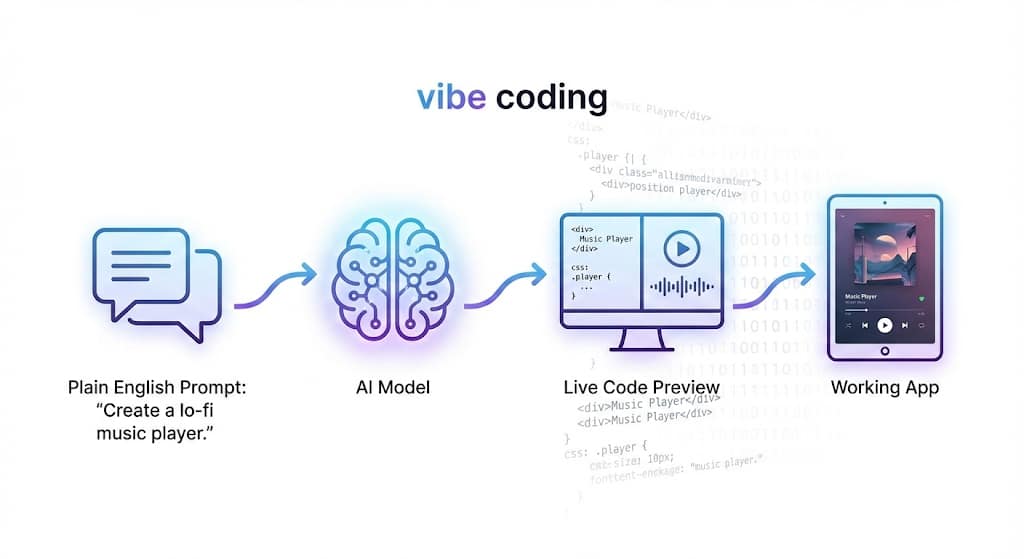
Capabilities of vibe coding include:
- Natural language programming: The user describes the required features rather than writing code, e.g., create a form and validate the email address field.
- Rapid iteration: Create functional prototypes in a short time rather than hours or days.
- Error correction through dialogue: Paste error messages back and forth with the AI to fix issues.
- Multi-language accessibility: Built in languages you’ve never learned by simply describing what you want the code to do.
- Automated deployment: AI can handle deployment locally or in the cloud with prompts.
Tasks that traditionally took developers hours can now be completed in minutes. Non-technicals can prototype ideas without a development team. Designers can create interactive mockups that actually work and test concepts before development.
The tools that make vibe coding possible
Several platforms have emerged as leaders in the vibe coding space, letting you build apps, preview code live, and publish:
- Browser-based builders like Replit, Lovable, and CreateAnything let you build complete web and mobile applications through prompts.
- Cursor is an AI-powered code editor where developers can describe changes and get help debugging, integrating with AI models for a pair-programming feel.
- Google’s Firebase Studio offers single-prompt app generation with one-click deployment to Google Cloud.
Beyond dedicated platforms, vibe coding can happen through ChatGPT, Claude, and other AI tools. Developers describe needs, upload code, receive snippets, and iterate conversationally. Voice-to-text tools like SuperWhisper can even replace typing.
From a simple animation to a mini game
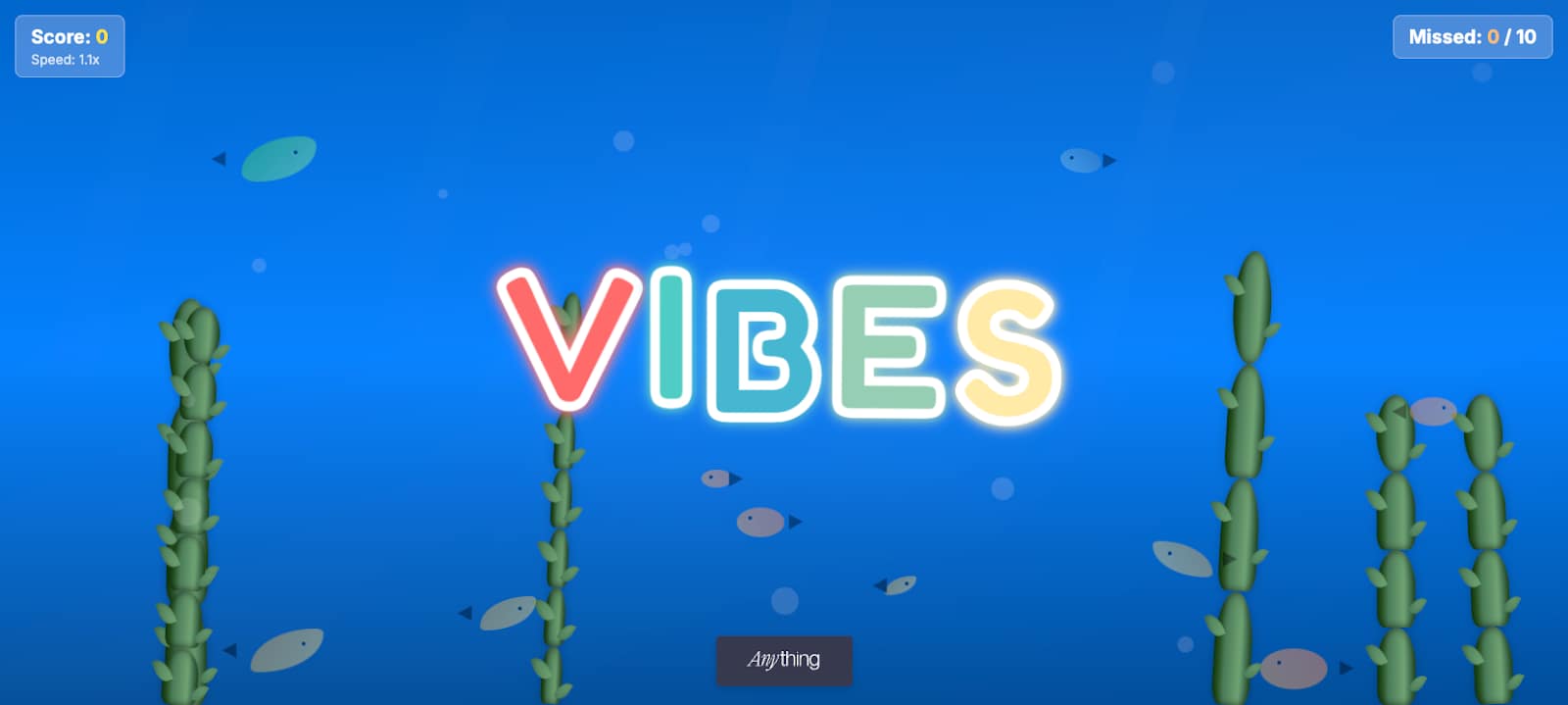
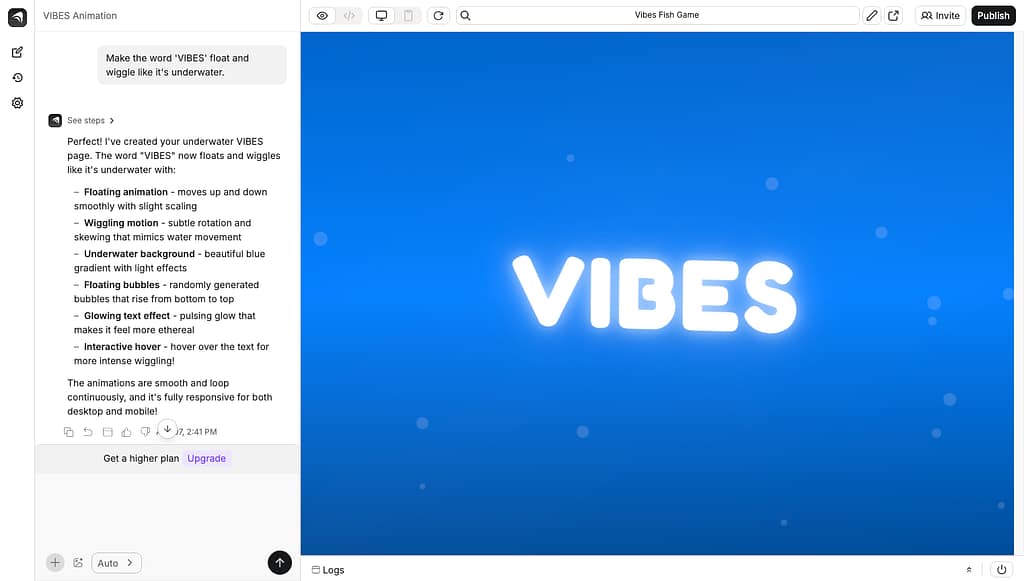
I experimented with vibe coding using CreateAnything. Starting with a simple animation, iterative prompts evolved it into a functional mini-game in under an hour.
- Initial prompt: “Make the word ‘VIBES’ float and wiggle like it’s underwater.”
- Refinements: Added colour, borders, individual letter movement, glow, sunlit water, fish, seaweed, score tracking, and game-over logic.
This is where vibe coding really shone. The AI restructured the application, adding game logic, score tracking, and fixed any issues along the way. What was once a simple animation had become a functional, simple game that can be deployed to the web and as a mobile application
The whole process, from idea to deployed prototype, took under an hour. You can see the resulting app in all its glory here.
Reality check: Where does vibe coding fit?
Vibe coding is powerful for specific use cases, but doesn’t replace developers entirely. Ideal scenarios include:
- Prototypes and demos
- Simple static websites and data collection
- Animation and visual effects
- Weekend projects and tools
- Learning via working examples
- Quick error fixes and code documentation
Limitations include maintaining complex applications, security risks, integration challenges, and long-term code maintenance. Maintaining a vibe codebase could become a nightmare, with stories of AI agents accidentally deleting databases, despite explicit instructions not to. Production applications with real users and sensitive data still need rigorous code review, testing, and human oversight.
The best approach is a hybrid model: use vibe coding to prototype and explore ideas rapidly, then bring in developers for production, security, and maintenance.
The future of development isn’t human or AI, it’s a blend working together, each playing to their strengths. And that future is looking incredibly exciting.
Behind the piece

More like this